What Sudoku is
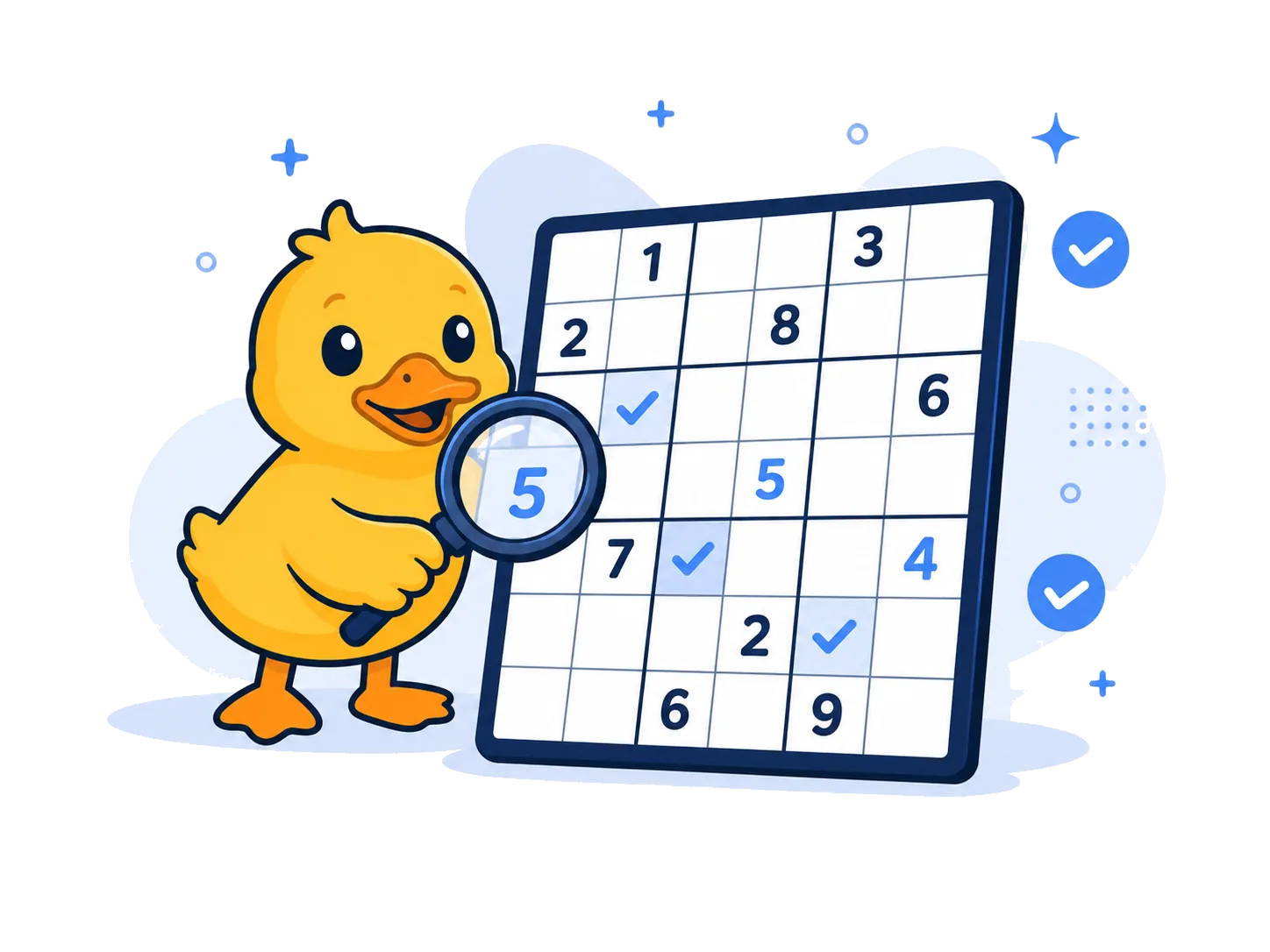
Sudoku is a number-placement puzzle played on a 9x9 grid. The grid is divided into nine smaller 3x3 boxes. Some numbers are given at the start. Your job is to fill the empty squares with the numbers 1 through 9 while following the same rule in every part of the board.
The rule is simple: each row, each column, and each 3x3 box must contain every number from 1 to 9 exactly once. You do not add, subtract, or use math facts. Sudoku uses logic and attention. The numbers could be symbols and the puzzle would work the same way.
The goal of the game
A solved Sudoku grid has no blanks and no repeated numbers in any row, column, or box. Every placement must fit all three areas at once. If a number is already in the same row, you cannot place that number in the square. If it is already in the same column or 3x3 box, it is also blocked.
Most Sudoku puzzles are designed to have one solution. That means each correct number can be found by logic. A beginner does not need to guess. If you feel stuck, the next step is to scan more carefully, write notes, or check whether an earlier number was placed incorrectly.
Rows, columns, and boxes
Rows run left to right. Columns run top to bottom. Boxes are the nine 3x3 regions marked by thicker lines. Every square belongs to one row, one column, and one box. When you test a number, you must check all three. A 6 might be missing from a row, but it still cannot go in a square if that square's column already has a 6.
Beginners often focus on only one direction. A good habit is to say the three checks quietly: row, column, box. This short routine catches most mistakes before they happen.
How to start a Sudoku puzzle
- Look for any row, column, or box with many numbers already filled.
- Find which numbers are missing from that area.
- Test one missing number against the crossing row or column.
- Place the number only when one square is possible.
- After placing a number, scan nearby areas again.
For example, imagine a 3x3 box is missing 2, 5, and 8. If two empty squares in that box see a 5 in their rows, then 5 cannot go there. If the third empty square does not see a 5 in its row, column, or box, that square must be 5. This is the basic shape of many Sudoku moves.
Using notes
Notes, also called pencil marks, are small candidate numbers written inside an empty square. They show which numbers may still fit. Notes are helpful when a square has two or three real options. They are less helpful when you fill every blank with every possible number before thinking.
Use notes after the first easy scan. Add a candidate only when you have checked the row, column, and box. When you place a final number, remove that number from notes in the same row, column, and box. This keeps the board clean and prevents old notes from causing mistakes.
Common beginner mistakes
- Placing a number because it looks good in a row without checking the column and box.
- Guessing when the board slows down.
- Writing too many notes too early.
- Forgetting to update notes after a new placement.
- Ignoring boxes and only scanning rows.
Mistakes are part of learning, but Sudoku becomes more pleasant when you slow down before each placement. If you cannot explain why a number belongs in a square, treat it as a candidate, not an answer.
A simple step-by-step example
Suppose the top-left 3x3 box is missing 1, 4, and 9. The top row already has a 1, so any empty square in that row cannot be 1. The left column already has a 9, so any empty square in that column cannot be 9. After checking those crossings, you might find that only the center square of the box can take 4. Place 4, then update the row, column, and box around it.
That one placement may unlock another. Maybe the same row now has only 1 and 9 missing. If one of the empty squares sits in a column that already has 9, that square must be 1, and the other square must be 9. Sudoku often grows from small chains like this.
Practice advice
Start with Easy Sudoku until the rules feel natural. Move to Medium when you can solve easy puzzles without many checks or mistakes. Keep a steady pace and learn to enjoy the search. A puzzle solved cleanly teaches more than a puzzle rushed with guesses.
It also helps to replay a solved puzzle in your mind for a minute. Pick two or three numbers you placed and ask what proved them. This short review trains you to recognize the same logic the next time it appears on a new board.